Showing posts with label St Barnabas Chapel. Show all posts

Thursday, April 28, 2011

SET IN STONE

The Melanesian Chapel of St Barnabas, on Norfolk Island, is probably one of the most beautiful and most visited historic buildings in all the islands of the South Pacific. Visitors to Norfolk Island are often surprised to find a little church in this remote place with an inspiring beauty and charm that is usually found in great cathedrals.

 St Barnabas' Chapel was built between 1875 and 1880. The Chapel was built as a memorial to Bishop John Coleridge Patteson, who had been appointed by Bishop George Augustus Selwyn as the first Bishop of Melanesia. The Melanesian Mission had first been located at St Johns' in Auckland, and students were brought there from the islands to train to take the Christian message back to their people. The climate in New Zealand proved unsuitable, and the Mission headquarters was moved to Norfolk Island in 1866.
It was in 1871 that the much loved Bishop Patteson was martyred at Nukapu in the Solomons, when he was mistaken for a "blackbirder' who had come to take young boys away to sugar plantations in Australia and Fiji. His death actually served as a catalyst to bring about an end to this "slave trade". However, there was also great sadness and mourning throughout the Christian world at the loss of this fine man, still in his early forties.
It was decided to build a chapel to his memory. Many of Patteson's colleagues and family back in England decided to subscribe to a fund build a fitting memorial, fulfilling a vision that the Bishop himself had witten about of "... beautiful Gothic Chapel, rich inside with marble and stained glass, and carved stalls and encaustic tiles and brass screen work...It may come some day, and most probably, long after I am dead and gone."
The building was designed by Sir Graham Jackson, a well-known British architect, and the work was carried out under the supervision of Dr Robert Codrington, who was the manager of the Mission set up on Norfolk Island.
 The building was to be of stone, which supported a soaring timber framework for the steep roof. For the main walls of the building, they used blocks of limestone which were quarried from the west side of Emily Bay on the south side of the island, and dragged the fiive kilometres to the Chapel site using bullock drays.
However, for the interior, particularly in the Chancel area, Codrington decided to lay alternate courses of local limestone and the lighter and more mellow Oamaru stone which was imported from the South Island of New Zealand, arriving in 1878. At the time, Codrington noted in a letter home how ironic it was that it was actually cheaper to bring that Oamaru stone by steamer all the way from New Zealand than it was to purchase the local stone!

The Chapel was consecrated on 7th December 1880, with great celebrations and festivities, which were enjoyed by up to fifty visitors mostly from New Zealand.
St Barnabas' Chapel was handed over for use by the Church of England on Norfolk Island in 1920, when the Melanesian Mission moved its headquarters to the Solomons.
It is a much treasured building, not only by the parishioners but the whole island, who take great pride in this beautiful icon.
It is, however, a mammoth task to maintain and preserve this valuable building. To this end, the church established a branch organisation called the "Friends of St Barnabas'" some years ago. the idea was that "The Friends" would devote their efforts to raising funds and carrying out necessary restoration projects, thus allowing the Church council itself to focus on ministry matters.
The restoration work is constant and ongoing, and this picture here shows the work that is currently being carried out on the timber work surrounding the William Morris Rose window, stripping back to the raw timber and repairing and replacing any rotting areas.
 Recently, The Friends of St Barnabas decided it was time to tackle restoration work on the Oamaru stone, which was crumbling somewhat in the Sanctuary area. The problem was not new. In fact, back in 1930, Henry Drummond wrote in a report that the stone was deteriorating and although attempts had been made to arrest the problem, they had not been successful. It would appear that the main problem was the proximity of the locally quarried limestone, which contained salt and which reacted with the sandstone.

The Friends of St Barnabas attempted to contact someone who knew about Oamaru Stone, and fortuitously Bill Dooley himself, the owner and manager of Dooley Masonry in Oamaru, would soon be honeymooning on Norfolk Island, and would be able to inspect the problem itself.
Bill arranged to send replacement stone to Norfolk Island, and at first he hoped to instruct some local tradesmen to actually carry out the work. However, this did not eventuate, and two or three years later, in March of 2011, Bill and his wife returned themselves with two of their workers, and carried out the task.
 I should point out that the deterioration in the stone was not particularly unsightly, nor was it hazardous. The main problem was the stone dust that the church cleaners had to deal with each week! Moreover, it was advisable to deal with it before it did present more severe problems.

This dust came from the restoration process - much worse than the weekly deposits the church cleaners encountered, but it is very white and really shows up.
Bill Dooley and his team got stuck into the job, and  soon had it all looking as good as new, Along the way they discovered other problems needing attention, such as dampness and drainage, which they were able to point out to "The Friends" and the Parish Council.
 As well as the salt problem, Bill felt that the instability may have been partly caused by the direction in which the Oamaru stone was laid. He said that it should always be positioned facing the same vertical direction in which it had been quarried.
 There used to be wall hangings in this sanctuary area, which were removed and laundered before the work was carried out. However, they proved to be in such bad condition, it was decided not to put them back.
Now everyone commented on how lovely it looked without them. You can now see the beauty of the stonework, and the sanctuary area was so light and airy! These beautiful windows, the work of Sir Edward Burne-Jones, seem to greatly enhanced.

 Keeping our precious "Father Willis" organ in good condition and tune is another important responsibility we have as caretakers of this lovely church.
 Things were in a bit of disarray while the work was being carried out, but Bill and the boys soon had it looking better than ever. In fact, Bill, obviously a man of great practical skills, even showed us how to fix this old vacuum cleaner that has been out of commission for some time! I should add that Mr Dooley has, on his own admission, reached his four score years, so we were very blessed to benefit from his enormous skills and expertise.
 Bill also has quite a sense of humour, and I could not resist photographing the labels on the crate that had brought the stone from New Zealand.

 I think you will agree that our Chapel of St Barnabas is a very special building, set in magnificent grounds, and well worth the effort of keeping it in a beautiful condition for present and future generations to enjoy. Last year we replaced the roof at a cost of around $200 000, and in the near future we will need to attend to the Devonshire marble floor, which has many loose tiles. Currently, a thorough stripping and re-painting of all the exterior timber is being carried out.
You will note from the picture above that St Barnabas' is built in the "school chapel" style, with seats facing each other across a central aisle. Most important is that the Chapel is a house of worship to this day, and as we express our faith and God's love in this place, we are mindful of that much-loved Bishop, of the faithful Mission workers, of the Melanesian students who gathered here, and of all those who have gone before us who have been inspired by this very lovely place.
An Afterthought
I have just remembered this little Oamaru stone vase, given to us by friends a few years ago. I note on the base of this vase it says it has been "silicone treated". Now I must admit I have sometimes wondered about the wisdom of replacing sandstone with the same thing, which may continue to react with the adjacent limestone. I think this is the answer, and I do recall Bill Dooley talking about "silicone" when we discussed the project with him!

Sunday, November 29, 2009


MR SHINGLES
Look who came into our  lives less than 24 hours ago!

We were out at the Chapel, doing some last minute cleaning before a special service today. Tim, one of the roof slaters came in and said: "I hear you like cats." (indeed I do.)
He took me outside to show me this tiny kitten cowering in the big clump of strelitzia, The boys said that it had been around for a few days. At one stage there had been a mother and 2-3 kittens, but the others seemed to have disappeared, leaving this poor little waif.
I said that I did not really think Bernie would like me to take it home, but they told me Bernie had already given it a name, "Mr Shingles", which is the name of the roofing firm carrying out the job on the Chapel.
Once home, Mr Shingles had to get to know the rest of the family.


 Digby was fascinated and delighted! He is quite fond of one of Charles' cats, but here was one of his very own!!!

I must admit he was not really happy about having Mr Shingles try to suckle him.


Later we introduced him to Roany, who was willing to give him the "once-over", but was not all that interested. One of Charles' cats already follows him round like a shadow, and he does not really want another one!


That evening William came up to stay while his Mum and Dad were at a wedding.
I think the pictures say it all!


Mr Shingles seems to be about 8 weeks old. He seems healthy and his eyes are bright and clear. But it is obvious that he has not suckled for a few days, and his body was like a little bag of bones.
But he has been eating and drinking well here, and I am sure he has already started to fill out.
I lost my beautiful cat Oliver to illness just a few weeks ago. I did not write about it because it was just too painful for me.


Mr Shingles will not take his place - but he will bring some healing.
I could not even have posted this picture (above) of Oliver before this!


Meanwhile I hope it is the start of a beautiful friendship between Digby and Mr Shingles!

Sunday, November 22, 2009

A TALE OF 3 DRAMAS
We have been involved in a big and long-awaited project of re-roofing our lovely St Barnabas Chapel. and I will tell you all about that in another posting.

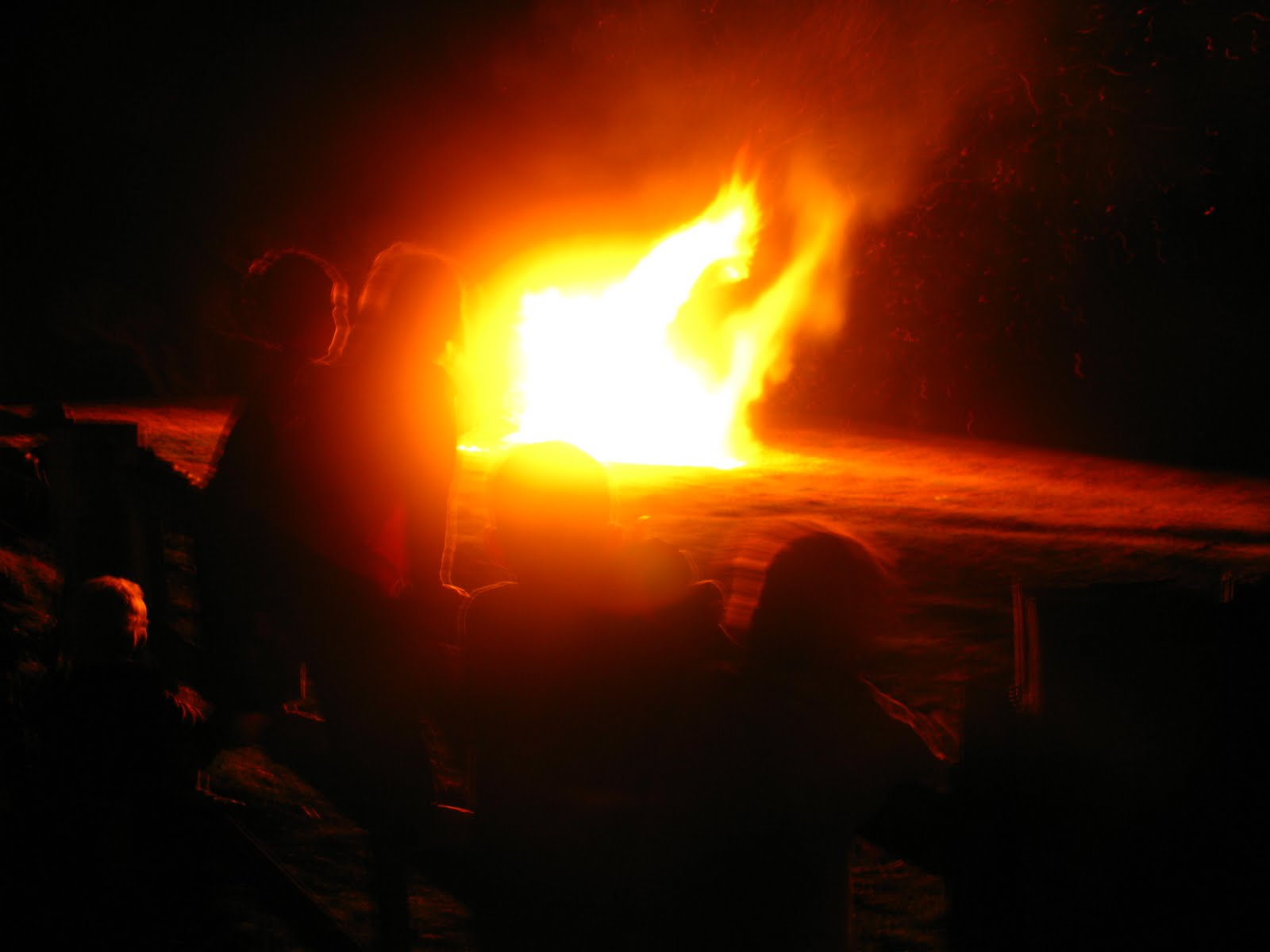
At the same time we have been replacing the timber fence along the road. With the old fencing, and the crates from the tiles, and other building and bush rubbish, the boys built an enormous bonfire in the paddock.
The other night, Chris and the boys who have come from Sydney to work on the roof decided that it would be a good idea to have a barbecue for all those who have taken an interest or been involved in any way. We started in the early evening with a game of Rounders (a great tradition on Norfolk at picnics and family occasions in the early days.)
This was the first drama. Poor Rod had only just gone onto the field, hit the ball, and while running to the first base managed to "do" his hamstring, resulting in a trip to the hospital. He later returned with ice, painkillers and crutches!

Meanwhile the children had fun on the swings and see-saw...
And others tried out the "Horizontal Bungee Jump" that Chris had rigged up from old inner tubes!
We enjoyed a delicious barbecue - and the three fellows shown here, as well as a couple of others who were there that night, had no idea that they were to be involved in an incredible drama later that night. The picture shows Darren, Chris, and Glen.


We had just finished our meal when we saw they had lit the bonfire in the paddock. We all gathered round to watch the enormous blaze..

After watching for a while, we drifted back to the barbecue ...and then the fire brigade arrived, acting on reports by phone from a number of people of the enormous conflagration in the area of the Chapel. The fire-ies saw that all was well and the fire engines were returned to their home at the airport. About this time. a little bit of rain started to fall, and we all cheered, because the island has been very dry for some weeks.
Now this is where the story starts to take an interesting turn.
Bernie and I were returning home about later in the evening, and as we passed the airport, we saw that all the lights were on both in the terminal and on the runway. We discussed what plane may be due - certainly not one of our usual scheduled flights, unless there had been delays. We noticed that the main street was quite wet, but the clouds seemed to have passed on and the sky was clear again.
We were just going off to sleep that night, when the phone rang. It was our son John, who said he and his mates were just putting out to sea in "Gran Lady" to look for the passengers of a Medivac flight which had been forced to ditch into the ocean when it ran out of fuel. It was flying a sick lady from Samoa, and had been given a good weather report from Norfolk Island and clearance to re-fuel here. However, the fog and clouds had come down quite suddenly and the visibility was too poor for the pilot to land. After two failed attempts and some circling, he realised he was very low in fuel and had no choice but to go into the sea, with the 5 other passengers - his co-pilot, two medicos and the sick lady and her husband.
Darren (who had been to the barbecue) - was the first boat into the water, and he had with him Chris, and also Glen, who is the airport manager. John and the others in Gran Lady were ten minutes later into the water, because they took time to take on large quantities of fuel, in case the search should prove to be extensive. The police directed both boats to head south towards Phillip Island, where the plane had last been seen.
Now a young fellow Scott,who had been in the fire crew who had come on the false alarm to investigate our fire, had heard all the news at the airport when they returned with the engines. Scott decided to take a longer route home around the coast on the offchance that he may see something - and off to the west of the island, he spotted some lights in the water. He relayed this information through, and the boats were advised to divert to this area. Darren and his mates found them quite quickly. With 3 or 4 lifejackets between them (there had been no time for the crew), they were treading water a couple of nautical miles off the island and the plane lay about 40 metres below. What is amazing is that the sharks had left them alone!
About an hour after his first call, John rang to tell us the good news, that all 6 were safe and well, and had been able to walk on the pier, although they were shocked and shaken.
So it may be that our bonfire was a blessing - call it luck, coincidence, or God's protection - but that fellow may never have seen those lights if he had not been called out on that false alarm to our bonfire!
Related Posts with Thumbnails